David Yu, FSA · uModel

One common language for actuarial modeling.

Products, assumptions, and regulations have always been modeled in different ways. uModel expresses them one way, so you can compose complex models from simple concepts.

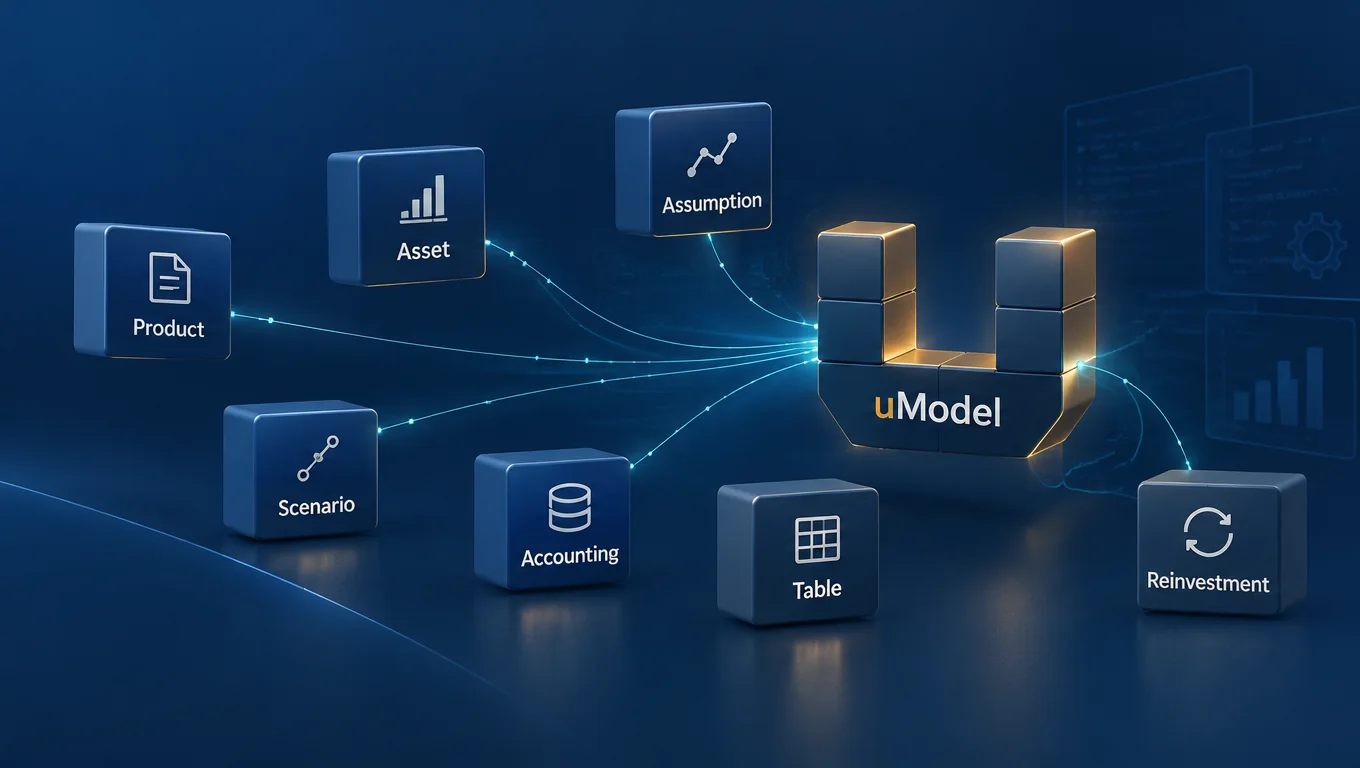
Product, asset, assumption, scenario, accounting, table and reinvestment blocks composing into uModel

Transparent, distributed, cloud native, and AI agent empowered.

16,000

seriatim contracts, per-contract solves

7 × 50

scenarios × projection years

2m 13s

full run on a desktop. Finding, 1 Sep 2026

The question

You know how the business should be modeled. Is there a simple way to just do that?

You can see the answer in your head: this benefit, that basis, this result. Then come the code, the run order, the timing, the aggregation and the reconciliation. That gap is where the years went: year after year of modeling, most of it spent on technical work rather than actuarial thinking.

The answer

Start from first principles.

Products, assumptions, and regulations come in endless variety, but underneath they rest on a small set of actuarial ideas. Working from those ideas rather than from each case's surface is what let us find one common way to express them all. Three things follow from it:

01

Composable

Do just that. Products are composed from building blocks, and you write only the economics of the case. Term, universal life, and deferred and payout annuities today.

02

Distributable

Each contract is its own unit of work, so a run uses every core of the machine.

03

Agent-ready

Inputs and outputs are well defined, and every number traces back to them. That gives an assistant something real to read.

What changes for you

01

Fast development

No more struggling with new product features and regulation.

02

Fast run

Built to distribute: every core engaged. Desktop-proven today, cloud native by design.

03

Powerful AI agent

Model with an agent that understands the input you’re working on, advises how to do it, and helps check for errors.

See what I deliver →

A new way of working: you decide what the model should do, and an agent beside you advises on each input and helps catch errors as you go.

Bold about the idea. Blunt about the progress.

Development maturity · October 2026 · stage reached, in quarters

Development stage reached for each modeling challenge, in quarters
Modeling challenge Architecture Core Build Applied Validation Pilot Readiness
Compose arbitrary contracts
Comprehensive, transparent output
Quantify income for cohorts and plan groups
Multiple currencies in one model
Nested projection
Composable reinvestment strategy
Planned: hedging strategy you define
Cloud cost
AI agent integration

each dot = one quarter of the stage complete

Findings

Proof, one chapter at a time.

Each one states what was run, what came out, and what it does not prove.

1 Sep 2026

Contract-level concurrency changes what a CPU can do

16,000 contracts · 7 scenarios · 50 years · 2m13s

Read the Finding →

In progress

Credit migration vs. default-as-expense

Next Finding. Published here when it's done.

Planned

An AI agent explains why a reserve moved

Follow the build to get it first.

All findings →
David Yu

I'm David Yu, FSA. I've spent decades building actuarial models for life insurers, and taught myself software engineering to build the system I kept wishing for.

More about me →

Follow the build.

The engine runs today; the platform around it is being built in the open. Occasional notes, no spam.

Privacy